If your blankets live on the couch, the bed, and occasionally your desk chair, these blanket storage solutions give each one a place to land. Choose a basket for the throw you reach for every evening, a shelf for spare bedding, or a covered container for the blankets taking a season off.
The fuzzy movie-night blanket can stay within reach. The guest blanket can wait somewhere you can find it when a friend decides to sleep over. Start with how you use each one, then see which of these spots fits your room.
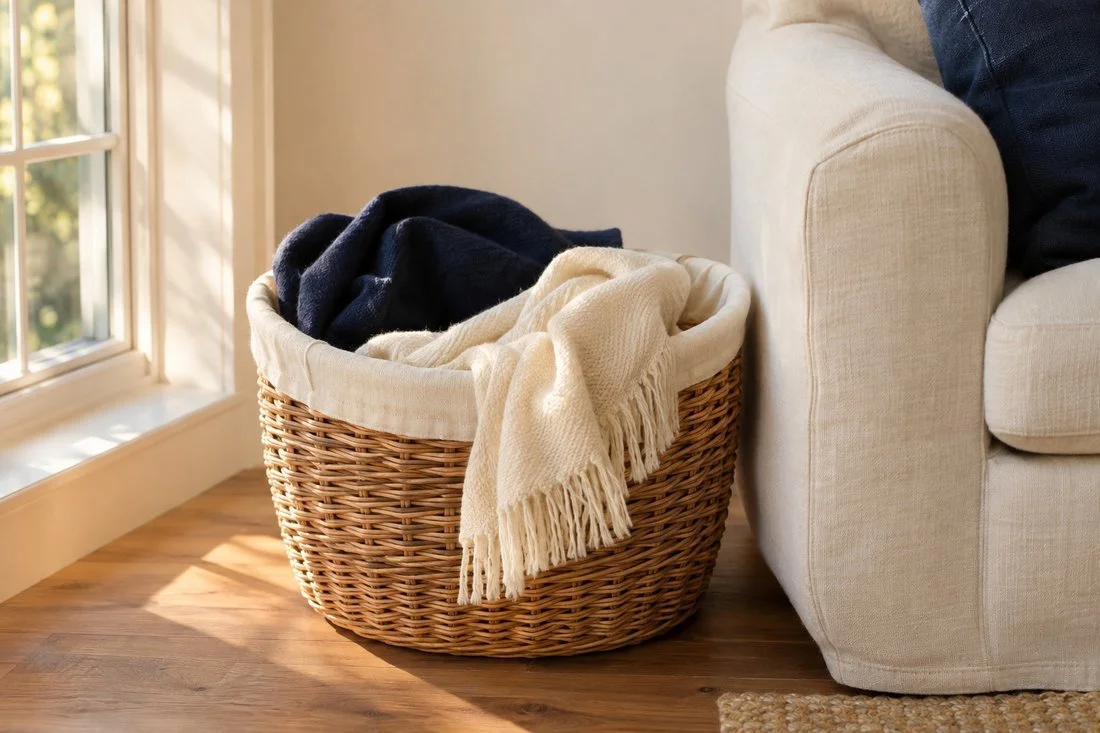
Choose blanket storage by how often you use it
Before buying anything, gather your blankets in one place. Include the one tucked behind a pillow and the spare at the foot of your bed. Fold them loosely so you can see how much room they actually need.
Make three groups: everyday throws, extra bedding, and seasonal blankets. You might have one in each group or several that move between rooms. Give each group its own storage spot so grabbing your favorite throw leaves the guest bedding where you put it.
| What you're storing | A spot to try | What to check first |
|---|---|---|
| The throw you use every evening | An open basket beside your seat | Smooth interior and room to lift the blanket out |
| A small collection you want to see | A shelf or blanket rack | Folded width, shelf depth, and safe installation |
| Spare bedding for sleepovers | A closet shelf or covered under-bed container | Access, usable interior dimensions, and clearance |
| Extra throws in a shared living room | A storage ottoman | Interior capacity and room to open the lid |
| Heavy blankets between seasons | A clean, dry covered storage spot | The care label and material-specific instructions |
If you already have a basket or an empty shelf, test it with your folded blankets for a few days. That gives you a chance to notice whether you like reaching down beside the couch or opening a closet before you add another piece of furniture.
Put an open basket beside your favorite seat
A basket works for the blankets that come out every day. Set it beside the couch, a reading chair, or the corner of your bed where you usually settle in. A little space above the blankets lets you pull one out without lifting the entire pile.
For a woven basket, run your hand along the inside before adding a knit throw. Rough ends can catch loose yarn or fringe. A smooth fabric lining can help protect a delicate blanket; check that the lining itself is clean and has no exposed fasteners.
To compare sizes, fold your largest everyday throw and measure the bundle. Check the basket's interior dimensions, including the opening. A wide handle or a tapered base can leave less usable space than the outside measurements suggest.
You can fold the blankets side by side or roll lighter throws. Leave a corner of the one you use most near the top. It can look a little lived in. Someone is probably going to pull it out again tonight.
For an evening outside, a handled basket can carry throws to a covered seating area. Bring the basket and blankets back indoors afterward. Our outdoor movie night ideas include ways to arrange seating for a backyard film.
Keep one throw folded on the couch or chair
Sometimes the storage spot is the seat itself. If one blanket gets used every evening, fold it over the back or arm of the couch when you're finished. This leaves the basket available for the extras.
To make a folded throw fit a narrow chair arm, fold it lengthwise first, then shorten it until the ends sit clear of the floor. Keep fringe away from moving recliner parts. If the chair folds or rocks, check its full movement with the blanket in place.
A draped blanket can also show a color or pattern you enjoy. A cream throw against a navy chair, a checked blanket over a plain couch, or the quilt you've kept since childhood can stay part of the room. Choose the fold that lets you sit down without rearranging everything.
For a shared couch, leave room for the people using it. A stack of six blankets on one cushion takes up an actual seat. Move the extras into your basket or closet and keep the everyday throw nearby.
Fold spare blankets on a closet shelf
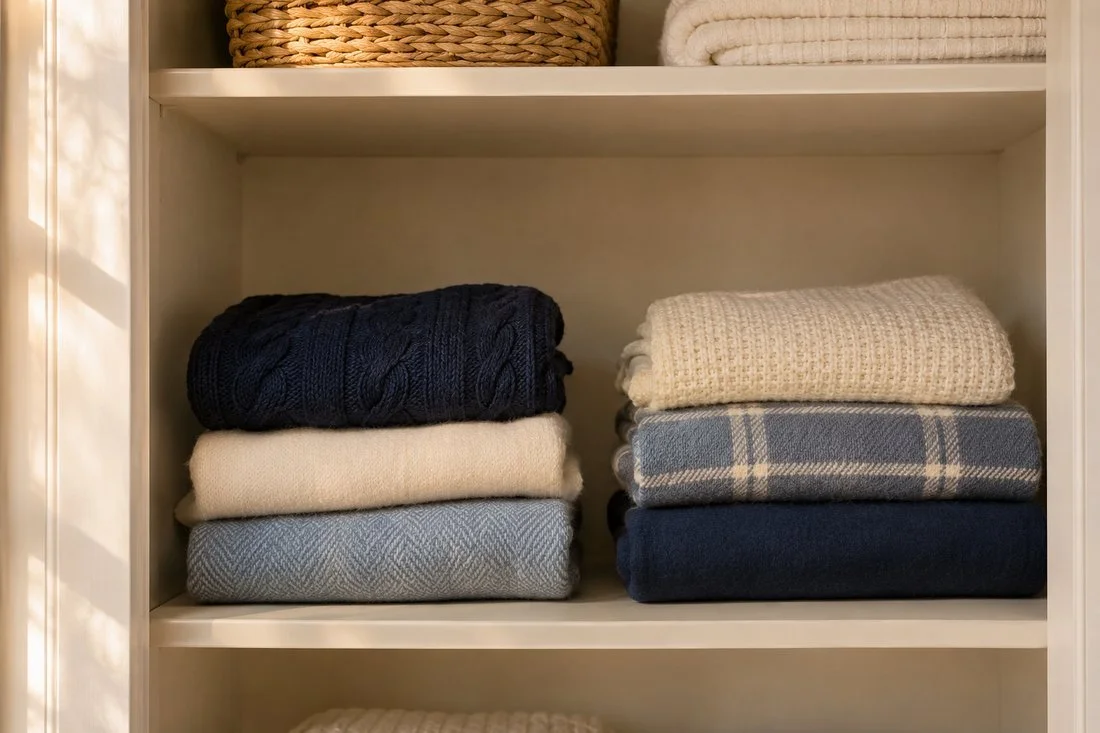
A closet shelf suits the blankets you want to keep ready for guests or a colder night. Fold each blanket to fit the shelf's depth, with the folded edge facing you. Keep a stack low enough that you can remove one without the rest sliding forward.
To fit several blankets, try storing them upright in a smooth-sided bin on the shelf. Check whether the folded bundles stand without being crammed together. A bin you can take down may work better than reaching into the back of a deep shelf.
Keep larger, heavier blankets where you can lift them comfortably. If you need a step stool, leave space to position it safely. An overfilled top shelf makes changing the bedding more of a production than it needs to be.
A small label can help in a shared closet: “guest blankets” or “winter bedding” says enough. If blankets belong to different beds, label by bed size. You can keep the matching sheet set nearby without squeezing it into the same container.
Use covered under-bed storage in a small bedroom
When floor space is limited, look under the bed before adding a basket. A shallow covered container can hold spare blankets while leaving the walking space around your bed open.
Measure the lowest clearance under the frame, including any center supports. Then check the container's full height with its lid, handles, and wheels. Leave enough room to slide it out from the side you can reach.
Next, measure a folded blanket bundle against the container's inside dimensions. The published measurements may describe the outside. A zippered bag also needs enough space around its opening for you to reach the blankets.
For a dorm or shared bedroom, keep your container on your side and follow the room's furniture rules. If the bed has an existing drawer, try that first. Avoid adding risers unless the bed manufacturer and housing rules permit them.
Store clean, completely dry blankets. If the area under the bed is damp, find another spot. A lid keeps a blanket covered, but it does not make a damp location suitable for bedding.
Try a storage ottoman when you need a seat too
A storage ottoman can hold extra throws in a living room or bedroom where you also want a footrest or seat. Before choosing one, check its usable inside dimensions with your folded blankets in mind.
If the lid lifts upward, leave room for it to open beside the couch or bed. If it comes off completely, decide where you will put it while reaching inside. You should be able to retrieve a throw without moving the coffee table every time.
For seating, follow the manufacturer's stated use and weight limit. Follow its hinge and lid instructions too, especially in a home with young children. A decorative blanket box and a seat may look similar while having different intended uses.
The Home Depot's blanket storage guide shows examples of ottomans, shelves, and baskets if you want to compare the shapes before measuring your room.
Display a few blankets on a rack
A purpose-made blanket rack can hold throws you like seeing, including a patterned quilt or a striped knit. Check the width of the rails against the folded blanket and keep the lower edge off the floor.
Choose a location that leaves doors, walkways, and furniture usable. For a leaning or wall-mounted design, follow the manufacturer's securing instructions and any rental restrictions. A decorative ladder is for display; use a proper step stool when you need to reach a shelf.
If a blanket has delicate stitching, loose loops, or long fringe, check that the rails and joins are smooth. A flat shelf may suit it better than hanging. Follow the blanket maker's care advice if the piece is heavy or fragile.
Store seasonal blankets clean and completely dry
For blankets you are putting away for several months, read the care label before cleaning or packing. Cotton, wool, fleece, electric blankets, and weighted blankets can need different treatment. Follow the instructions for the actual blanket you own.
For wool specifically, Woolmark's blanket-care guidance recommends storage in a cool, dark place in an airtight container or bag. Keep that advice specific to wool rather than treating it as a rule for every textile.
Before choosing a vacuum bag, check whether the blanket manufacturer permits compression. If you cannot confirm that, use a container that fits the folded blanket without forcing it down. Keep a note on the outside so finding the winter blanket does not mean opening every bag.
Questions about blanket storage
Is it better to roll or fold blankets?
Try rolling lightweight throws in an open basket and folding larger blankets for shelves. Choose whichever lets you remove one without disturbing the others. Follow any material-specific care instructions, especially for delicate or heavily textured pieces.
Where can I store blankets without a linen closet?
Try an existing bedroom drawer, a covered under-bed container, a smooth basket, or a storage ottoman. Measure both the available space and a folded blanket before choosing. Start with furniture and containers you already own.
How do I keep a blanket basket from overflowing?
Keep it for the blankets you use regularly in that room. Put spare bedding and seasonal blankets in their own spots. After folding the everyday throws, leave enough room to lift one out without pulling the rest along.
Can I leave a basket of blankets outside?
Bring it out for the time you are using it, then return it to a dry indoor spot. If blankets become damp, let them dry fully according to their care instructions before putting them away.
What should I measure before buying blanket storage?
Measure a folded blanket bundle, the available floor or shelf space, and the route for opening the lid or pulling out a drawer. For under-bed storage, include the frame's lowest clearance and center supports. Check usable interior dimensions as well as the outside size.