How to not feel awkward in front of the camera
If you have been quietly wondering how to not feel awkward in front of the camera before your senior session, you are asking the thing almost everyone asks. It comes up in the studio in Bolivar most weeks, usually about four minutes in, usually said as a joke.
The feeling is common and it is real. The second someone says "okay, I'm going to take your photo now," your body forgets how to exist naturally. Your arms feel attached wrong. Your smile feels borrowed off somebody else's face.
Here is what actually helps. Most of it is stuff we watch happen in real sessions every week.
The first few minutes are the warm up
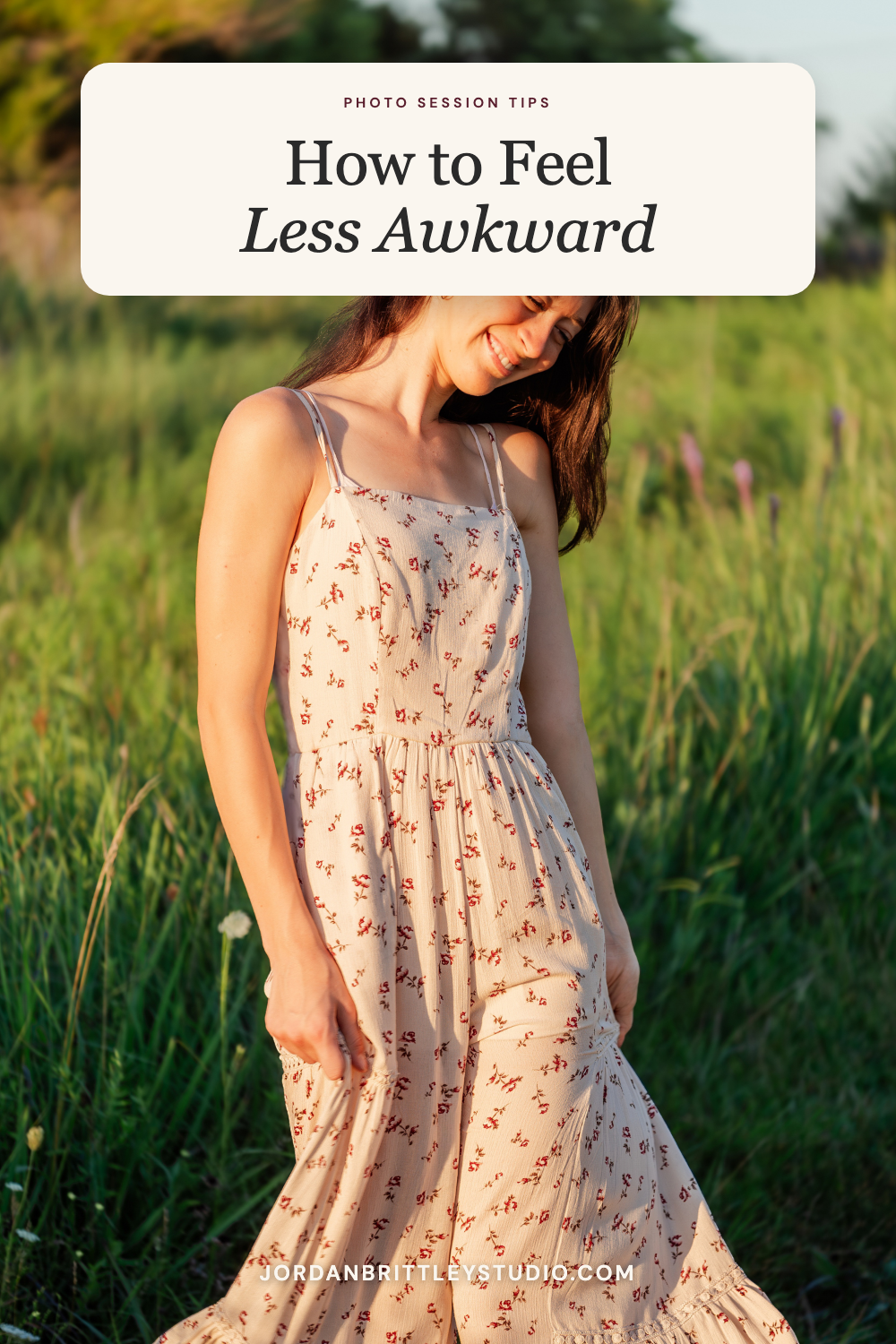
Give the first few frames permission to be weird and they stop being something to feel insecure about.
Almost nobody walks in already loose. Those first minutes are where your shoulders come down, where you work out where to stand, where you stop hearing the shutter. That is built into how we run the time. Nobody is grading frame nine.
What stretches the awkward stretch out is trying to skip it. Apologizing for it, tensing up about how long it is taking, asking whether you are doing it wrong. All of that keeps your attention pointed at yourself, and a face under supervision looks like a face under supervision.
We have not had a session stay stuck there. It takes a few minutes to find the rhythm and we plan for those minutes instead of rushing them.
Move instead of holding still
Holding a pose is genuinely hard. Your body is being asked to freeze in a shape it did not pick, and it will tell on you.
Movement handles most of it. Walk slowly toward us. Turn and look back over your shoulder. Sit down on the step, then stand up again. Lean on the wall behind you and let your weight settle into it. Fix your jacket. Take three steps and stop wherever stopping feels right.
When your body has a job, your face stops getting managed. That is usually the moment the photo shows up.
Most of what you will hear from us is a small instruction like that rather than a pose to hold. If a direction feels strange while you are doing it, that is normal, and it is often the one that works.
Have something to react to
A real expression needs something to be a reaction to. So we give you something.
We talk to you. We ask about the season you are in, the class you are dreading, the thing you are actually excited about. We put on music you picked. Sometimes we say something ridiculous purely to see what your face does with it.
Your part is to answer for real instead of managing how the answer looks. Laugh when it is funny. Roll your eyes when it earns it.
If you want to help this along before you arrive, build a playlist. It sounds like a small thing and it changes the whole room.
You do not have to look at the lens
Eye contact with a lens is a strange thing to ask of a person, and plenty of people lock up the second they try it.
You have options. Look off to the side. Look down and come back up. Look at something in the middle distance, like the end of the street. Look at whoever came with you. Close your eyes and open them on a count of three.
We direct this as we go, and you can also just say you would rather look away for a while. That is a normal thing to ask for and it usually produces something worth keeping.
Bring a person, or something that is yours
Most people are looser with something familiar in the frame.
A parent or a friend in a chair off to the side. Your dog. Your car. The instrument, the jersey, the boots you actually wear on a Tuesday. Something of yours in the frame gives you a thing to think about other than being photographed.
A few things that help before we start
Some of this gets decided before you arrive.
Eat something. Sessions run longer than people expect and low blood sugar shows up on a face.
Sleep, if the night before cooperates.
Get there a few minutes early so you are not walking in off a parking-lot sprint.
Pick a time that is not wedged between two stressful things.
Sort your outfits in advance so that is not the thing riding in your head. The senior picture outfit ideas guide covers that side of it.
If you want the full walkthrough of how the day runs, how to prepare for senior pictures goes start to finish, and what nobody tells you about senior photoshoot day covers the parts people are surprised by.
What we are doing on our side
You are not carrying this by yourself, and it helps to know what is happening while you are standing there.
We are watching your shoulders and your jaw, and we change the direction before you notice the last one stopped working. We are choosing spots with something to lean on or walk toward, because an open field with no landmark asks more of a person than it looks like it does. Our Bolivar High School senior photo locations list is built partly around that.
We are shooting through the in-between moments. The walk back. The laugh after the take. The part where you think we stopped.
And we tell you when something is working, because most people cannot feel that from the inside.
We have seen every version of this
There is nothing you can do in front of this camera that has not already happened in the studio.
Every kind of nervous. Every kind of stiff. The ones who talk the entire session and the ones who go quiet. The ones who ask three separate times whether they are doing it right. All of it has come through Bolivar and the 417, and all of it has ended with photos people were glad to have.
Plenty of seniors who told us up front that they were bad at this walked out with a gallery they were excited to show people. If you want the short version of that, the senior photoshoot pep talk is right here.
The awkward part is the warm up
It has a beginning and an end, and the end shows up sooner than most people expect. Usually around the time you stop keeping track of it.
If you want to talk any of this through before your senior session, bring it up when we plan the day. It is a normal thing to ask about!